AI Does Not Pick the Best. It Picks the One It Can Describe
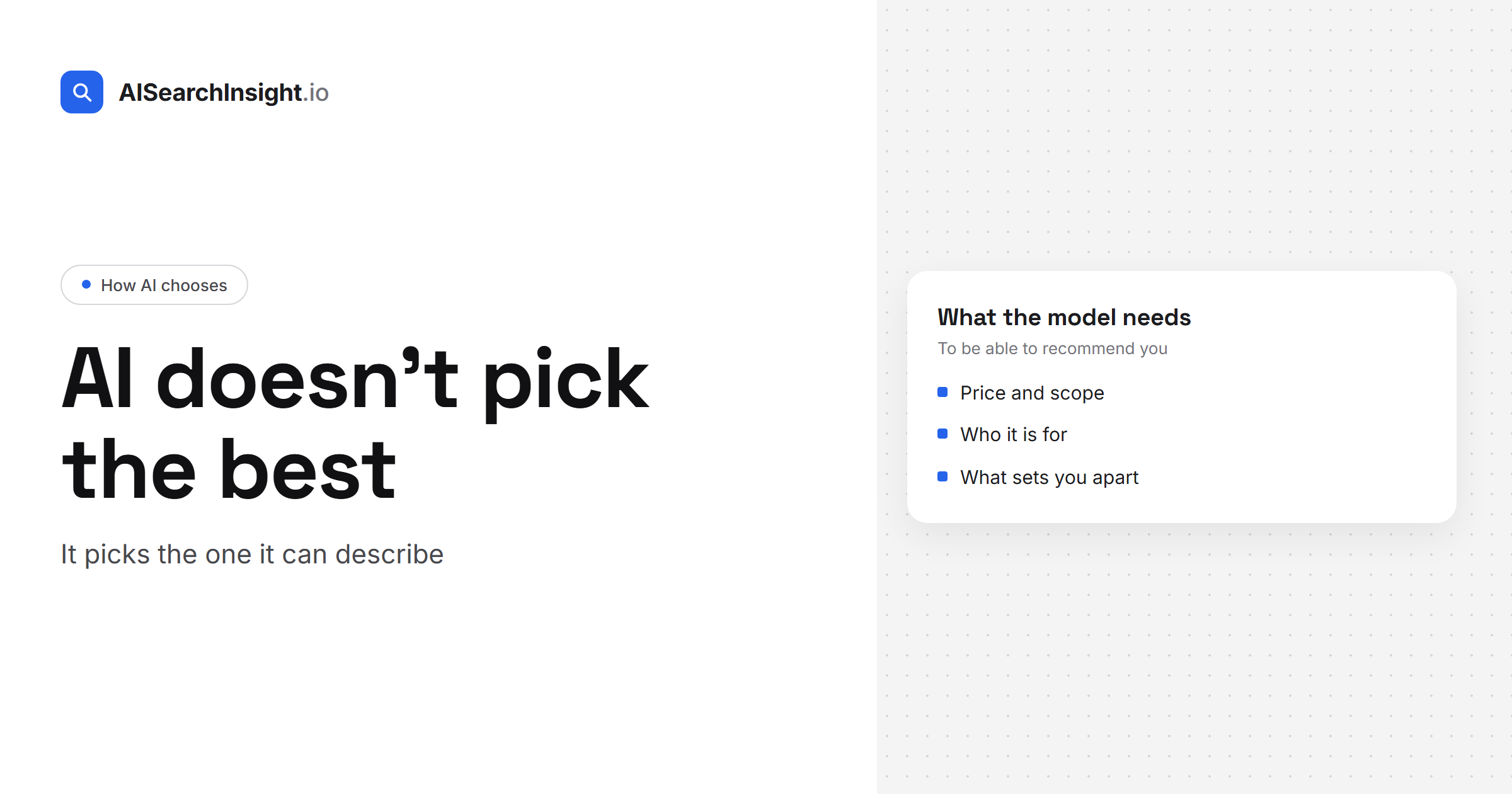
A customer asks ChatGPT for a supplier in your category. They get three names with reasons attached. You are not among them.
The first thought inside the team is always the same: it must rate us lower. After dozens of these conversations I can tell you that this is almost never what happened. The model did not assess your product and find it weaker. It simply had nothing to write a defensible sentence about you with - so it wrote a sentence about someone else.
It sounds like a small distinction. In practice it changes the entire task list, because "we have to be better" turns into "we have to be describable", and the second one is a month of work.
This piece explains the mechanism behind the choice:
- why an answer is not a ranking but a match against the condition in the question
- why a model skips what it cannot justify
- how category assignment decides whether you are a candidate at all
- why the absence of "who this is not for" works against you
- what to do when a competitor is simply better known
An answer is not a ranking, it is a match against a criterion
People do not ask who is best. They ask within constraints: for a company of twenty, with an integration to a specific system, under a given budget, in a particular country, deployed outside working hours.
Every one of those questions is a different contest. A brand that loses the general "best X" can win five specific queries - and the other way round, the category leader often gets skipped on narrow use cases, because nobody anywhere wrote that it covers them.
A half-hour exercise: write down ten criteria customers genuinely choose by in your category. Not benefits, criteria. Then mark, for each one, whether a sentence exists anywhere on the web from which it follows that you meet it. Usually it turns out to be two or three.
The model skips what it cannot justify
Systems that answer questions avoid claims they have nothing to support. That is not courtesy towards your competitors, it is how they are built: skipping a brand is cheaper than risking a sentence nothing backs up.
So an empty description does not mean neutrality. It means absence.
The material that works inside a justification is always concrete:
- a price or a range - "from this to that" is enough, an exact figure is not required
- scope - what is included and what costs extra
- limits - minimum order size, markets served, technical requirements
- who it is for - type and size of company, industry, stage
- integrations and compliance - what it works with and what it does not
- proof - deployments, numbers, certifications, anything verifiable
Marketing adjectives do not work in this role. "A comprehensive solution tailored to the client's needs" makes it impossible to write any sentence about you in answer to a question with a constraint in it.
One source is not enough, repetition is what counts
A model builds its picture of a brand from many sources at once and treats as settled whatever agrees across them. When it hits a contradiction - one service name on the website, another in a directory, a third in an interview - it goes with the version that repeats, not the one that is most current.
Your own site is one voice in that arrangement. An important one, being the source, but one. If it says something nothing else confirms, the model has a weak basis for repeating it.
Hence a common and misleading symptom: a company finishes a big website redesign, has everything described impeccably, and the answers still carry its description from three years ago, because that is what sits in all the other sources.
The report shows this from the results end, not from guesswork. We run a fixed set of questions through ChatGPT, Gemini, Claude, Perplexity and Google AI Overviews, then list which brands appear in the answers and against which questions. Two things become visible at once: the criteria where you are a candidate, and the ones where the model consistently names somebody else. It is usually the most uncomfortable and most useful table in the whole report.
See who AI names instead of you
The report shows the brands appearing in answers from ChatGPT, Gemini, Claude, Perplexity and Google AI Overviews in your category - split by the questions where you are present and the ones where you are missing.
The category you have been filed under
Before a model compares you to anyone, it has to accept that you belong to the set of candidates. That assignment comes from how you describe yourself and from how others describe you.
A company that appears everywhere as a "marketing agency" is not a candidate for a question about an SEO agency for online stores. A manufacturer that calls itself a "provider of solutions for industry" is not a candidate for a question about a specific material and its parameters. You are not losing the comparison - you are not entered in it.
What to do about it: name the category outright wherever you can, and add the use cases. Not "solutions for business", but what it is, who it is for and what it does. The same applies to directory profiles and to the descriptions you hand to journalists.
Not saying who this is not for hurts more than it looks
This is the most counterintuitive point on the list.
A description that promises everything to everyone gives the model no criterion to match against. A description that states plainly "this makes no sense below a certain scale" or "we do not serve that market" gives the model a condition it can select you on when the condition is met.
You see it most clearly in comparative answers. Brands with a clearly drawn boundary of use show up in sentences like "if X matters to you, Y makes more sense". Brands without a boundary do not appear in such sentences at all, because there is nothing to set against anything.
A stated limit does not shrink your reach. It increases the number of questions where you are an unambiguous answer.
When a competitor is simply better known
It has to be said honestly: part of the advantage comes from recognition, and no single quarter of content work will close that gap. A brand named in hundreds of sources holds a lead that a better service description will not cancel out.
The conclusion is not that there is nothing to play for. It is that the game is played over criteria, not over position in a general list. Narrow use cases, a specific market, a specific company size, a specific integration - that is where describability decides rather than recognition, and that is where smaller brands win regularly.
That is why I always start with the specific questions rather than the general ones. The general ones show how far the leader is. The specific ones show where winning is possible at all.
What to do this week
- Write down ten selection criteria in your category, phrased the way customers ask.
- Check across the five engines who appears against each one, and note where you do not appear at all.
- Add the missing facts to your own site: price ranges, scope, limits, who it is for, integrations.
- Add a comparison section - an honest side-by-side with the nearest alternative, including the cases where the alternative is the better choice.
- Repeat the category description everywhere you control: profiles, directories, press materials.
- Record your starting point. Without it, in three months you will not tell an effect from the variability of the answers.
Points three and four are what the GEO audit checks. A separate group of checks covers exactly whether a page can be cited: whether the answer to the question comes first, whether the claims are concrete and verifiable, whether there are comparison blocks, pricing tables and "if X, then Y" structures. In the Pro package you get that alongside the measurement of your brand's presence across the five engines, so both sides are visible at once: what the model could write about you and what it actually writes.
Check whether the model has anything to describe you with
The GEO audit of your site plus a measurement of your presence in ChatGPT, Gemini, Claude, Perplexity and Google AI Overviews - compared with your competitors.
The hard part of this shift is not the execution. It is accepting that quality is not what is at stake. Teams are trained to defend the product, and here there is nothing to defend - the model did not pass a negative judgement on you, it had nothing to pass one with. The material for that judgement is yours to supply.