Link Building in the AI Era: Why I Now Look at a Site's AI Visibility, Not Just Its Domain Rating
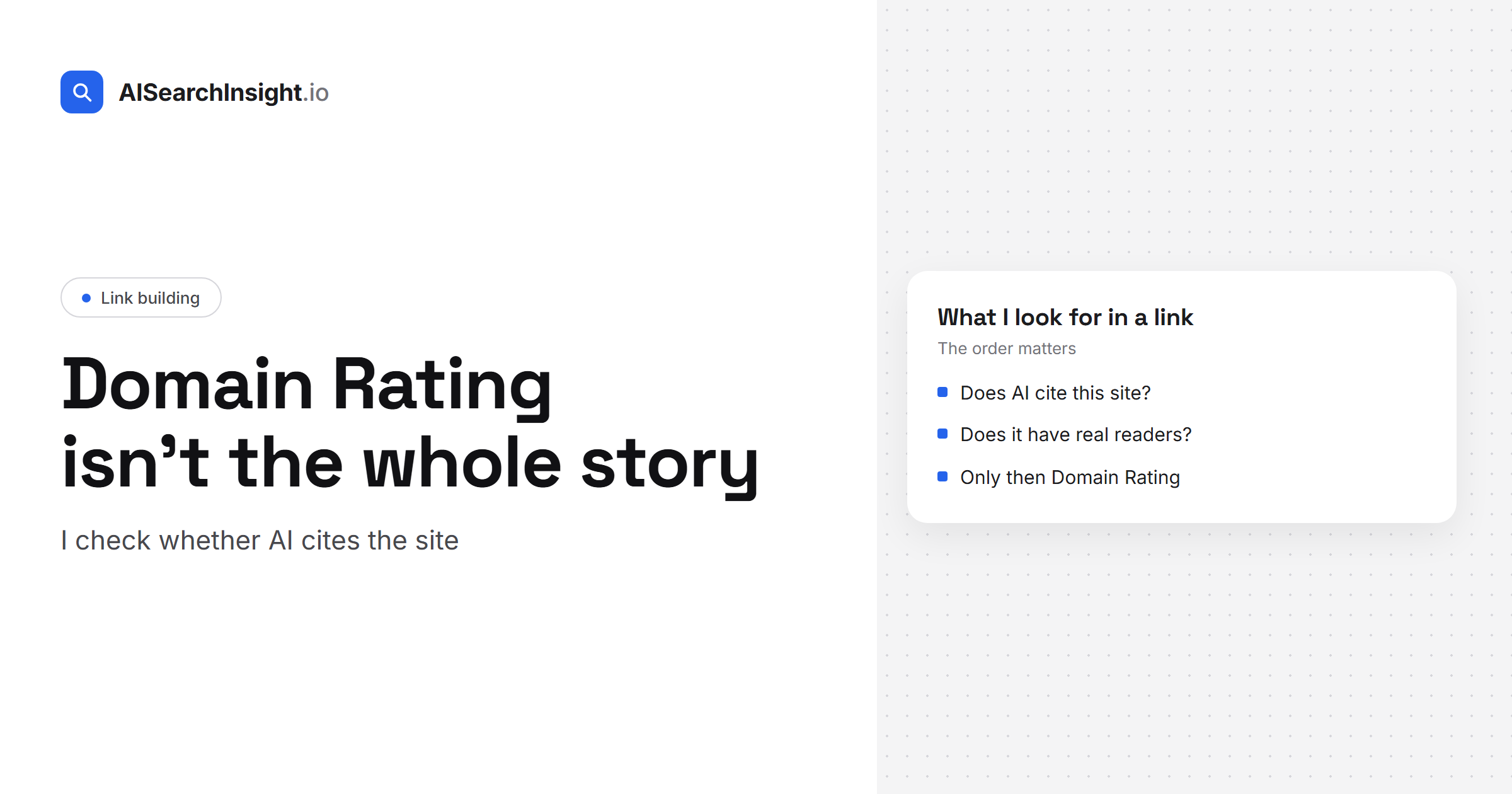
In more than a decade of building organic visibility, I've learned one thing: the criteria we use to choose sites for mentions are never set in stone. They shift along with the algorithms. Until recently, when I picked a place to publish an article or a mention, I looked primarily at three things: Domain Rating, organic traffic in Ahrefs, and the ratio of outbound to inbound links. Today I've added a fourth criterion - one that's increasingly the most important: how strongly the site is visible inside AI models.
The old criteria haven't disappeared - they've just stopped being enough
The classic metrics toolkit was built for a world where the only "reader" of our mention was Google's algorithm. A high Domain Rating suggested a strong link profile. Organic traffic confirmed the site was genuinely alive. A healthy in/out link ratio kept us from publishing on something that looked like a link farm. For classic SEO, that was - and still is - a sensible approach.
The problem is that our content now has a new reader: generative engines. ChatGPT, Perplexity, Google AI Overviews, and Gemini don't read the web the way Google's crawler does. And, crucially, they don't cite the same sources that rank in the top 10.
The scale of that gap is bigger than most people assume. A Moz analysis found that roughly 88% of citations in Google's AI Mode come from outside the organic top 10. For ChatGPT, the overlap with Google's leading results is sometimes reported in the low single digits. In other words, the fact that a site ranks beautifully in classic SEO tells us almost nothing anymore about whether AI models will pull the content published there.
What the data actually says about Domain Rating and AI citations
Here I have to be honest, because the data is nuanced and refuses to collapse into a single headline.
On one side, there are studies that all but bury domain authority as a predictor of AI visibility. Analyses cited by Clairon and Wellows point to a correlation between Domain Authority and citation probability of around r ≈ 0.18 - meaning DA explains only a few percent of whether an AI uses your content. An even stronger signal comes from an Ahrefs analysis of 75,000 brands: brand mentions across the web correlate with AI citations at roughly 0.664 - about three times stronger than backlinks (around 0.218). That's a fundamental shift in logic.
On the other side - and I won't gloss over this - there's research showing authority is far from dead. SE Ranking analyzed 129,000 domains and found a site's link profile (its number of referring domains) to be one of the strongest predictors of ChatGPT citations. A study of 1,000 Google AI Overviews responses found a positive correlation between Domain Authority and citations of +0.61 - because AI Overviews draw from Google's index and still weight authority heavily. Seer Interactive measured the correlation between organic rankings and LLM mentions at 0.65 - positive, but a long way from perfect.
How do you reconcile that? My takeaway from the trenches: Domain Rating isn't useless, but it has stopped being a sufficient condition. Authority helps, especially in index-based environments. But AI visibility has become a separate axis that the old toolkit simply doesn't measure. And that axis is what decides whether our mention actually works in the world of generative answers.
Two reasons I now look at a site's AI visibility
When I evaluate a site for publication, I ask directly: is this site - and how strongly - already present in AI model answers? I check it with tools that now measure AI visibility (including Ahrefs Brand Radar, Semrush, and specialized platforms). I do it for two concrete reasons.
First - the "borrowed trust" effect. If an AI model already treats a site as a credible source on a topic, the odds rise sharply that content published there will be treated as source material too. We land in the pool the model already likes to draw from.
Second - the mention itself can show up in citations. A well-prepared article, published on a site that's present in AI, has a real shot at appearing directly as a cited source in answers. That's no longer just a signal to the algorithm - it's direct brand visibility at the exact moment a user is making a decision.
What our own analyses have taught me
In the analyses we run, I've repeatedly seen a phenomenon that clashes with classic SEO intuition: AI models keep reaching for sites with relatively low organic visibility - provided their content is properly prepared. Low Domain Rating, modest traffic - and yet steady citations.
That's consistent with the broader data. In its citation benchmarks, Averi notes that low-DR sites with original research often achieve a higher citation rate than strong domains with thin content. A cross-platform analysis of trust signals (Neil Patel) found that mentions in external, credible publications earn the highest scores of any signal studied - higher than backlinks, whose weight swings dramatically from platform to platform.
So what decides whether content gets cited? The foundational academic work on GEO (Aggarwal et al.; Princeton, Georgia Tech, the Allen Institute, IIT Delhi) showed that adding concrete statistics, quotations, and source references can lift visibility in generative answers by up to around 40%. On top of that: freshness (AirOps research indicates the clear majority of ChatGPT citations go to content updated within roughly the last 10 months), clear expert authorship, and - importantly - the absence of a pushy promotional tone. Content that reads like an ad gets cited less often.
Check a site's AI visibility before you invest in it
The Pro report gives you a gap analysis of mentions and links: where your competitors get cited and where you are missing.
How to actually find the right sites
The operational conclusion is simple: before you invest in a placement, check the target site's AI visibility, not just its DR and traffic. But that raises a practical question - where do you even start the candidate list?
The fastest route is to flip the problem: instead of guessing, find out which sites are already cited most often by AI models in your industry. That's a ready-made, tailored list of places worth pursuing for mentions. That's exactly what we show in the one-off AI search visibility report at aisearchinsight.io - the report reveals which sources AI models reference most often in your category. For link-building planning, it's simply a map of the terrain.
Leave the execution to people you trust
One important caveat, because I want to be clear: we're not an agency, and we don't run SEO or GEO campaigns. Our job is to give you a reliable picture of how your brand performs in AI visibility and where the opportunities are. The campaign itself - landing placements, digital PR, producing content that AI will cite - is best left to people who do it every day. That's why we work with vetted partners who can run those efforts. You'll find the list here: aisearchinsight.io/us/partners.
A shift that's already happened
After more than a decade in this field, I've learned that the metrics treated as gospel yesterday become just one signal among many tomorrow. Domain Rating, traffic, and link ratios still matter - but they no longer tell the whole story. Today, when I choose a site for a mention, my first question is: do the AI models already trust it?
And how are you evaluating sites for link building these days - still the old way, or are you already factoring in their AI visibility?
See who gets cited instead of you
The report lists the brands and domains that ChatGPT, Gemini, Claude, Perplexity and Google AI Overviews name in your category.