How Different Countries Use AI Search: The Adoption Map You Won't See in Google Analytics
AI search is being adopted faster than the internet or the smartphone were in their day - but the growth is wildly uneven. Which country and which AI engine your brand is visible in is becoming a strategic dimension of its own.
AI search has stopped being a curiosity. According to the Microsoft AI Diffusion Report, by the end of 2025 roughly one in six people worldwide were using generative AI tools (16.3% of the population). In the first quarter of 2026, the share of the working-age population (ages 15-64) using AI reached 17.8%, and the number of economies that crossed the 30% threshold grew to 26 countries.
That's the good news: it's growing fast. The bad news for marketers is that it's growing wildly unevenly - and that unevenness is the whole story for anyone building brand visibility.
First, the scale: why we're even having this conversation
Microsoft says it plainly: AI is spreading faster than the internet, the personal computer, or the smartphone did at comparable stages. ChatGPT hit 900 million weekly active users in February 2026 (OpenAI's own figure), and by July 2025 it was already processing roughly 2.5 billion queries per day.
For context: this doesn't mean Google is finished. Analysis from SE Ranking (63,987 websites, January-April 2025) shows AI-platform traffic is still a sliver of the total - about 0.13% in the U.S., 0.12% in the EU, and 0.07% in the UK. But the pace is what matters: according to Datos, AI-tool adoption tripled in the EU/UK and more than doubled in the U.S. in a single year. At that doubling rate, the "sliver" becomes serious far sooner than the media hype suggests.
The country leaderboard: who actually uses AI
The hardest country-level data comes from the Microsoft AI Diffusion Report, because it measures real usage (anonymized telemetry, normalized for population, internet access, and device share) rather than survey self-reports.
- United Arab Emirates - 64% (H2 2025) → 70.1% (Q1 2026) · #1 worldwide
- Singapore - 60.9% · #2
- Norway - 46.4% · Europe's leader
- Ireland - 44.6% · top tier
- France - 44.0% · top tier
- United States - 28.3% (24th) → 31.3% (21st) · a giant playing catch-up
The UAE doesn't lead by accident. This is a country of roughly 11 million people that announced a national AI strategy back in 2017 and pushed AI into public services early. The common thread among the leaders (UAE, Singapore, Norway, Ireland, France, Spain) is always the same trio: early investment in digital infrastructure, in skills (AI skilling), and adoption by the government itself.
The U.S. paradox: the home of the models that barely uses the models
The most interesting takeaway in the report: leading on infrastructure and model development does not make you a leader in usage. The U.S. builds the strongest models and the most data centers, yet in H2 2025 it ranked just 24th (28.3% of the working-age population) before climbing to 21st in Q1 2026 (31.3%).
Microsoft's explanation is simple: smaller, highly digitized economies adopt faster. Paradoxically, the U.S. remains the largest market of paying ChatGPT subscribers - its huge population carries weight - but in percentage terms more than a dozen smaller countries are ahead.
Asia is accelerating - and language is the reason
The fastest mover in the rankings was South Korea: a jump from 25th to 18th, more than 30% of the population, and the title of the world's second-largest ChatGPT subscriber market. What drove it? A combination of three things: government policy, better Korean-language models, and features that resonated with users - in April 2025, "Ghibli-style" graphics from ChatGPT flooded Korean social media and pulled in a wave of first-time users, many of whom stuck around.
In Q1 2026, the biggest upward moves came from South Korea, Thailand, and Japan - and Microsoft explicitly ties this to improved model quality in Asian languages. That's a signal you can't afford to miss: the language barrier acted like a brake, and once it eases, adoption explodes.
The Global South and the DeepSeek phenomenon
The flip side: the gap between the Global North (27.5% of the working-age population) and the Global South (15.4%) keeps widening. But a revolution is happening here too - driven by DeepSeek. An open model under an MIT license with a free chatbot demolished the cost and technical barriers (no credit card, no paid upgrade). The result? DeepSeek usage surged across China, Russia, Iran, Cuba, Belarus, and all of Africa, where usage is estimated to be 2-4× higher than in many Western countries.
Microsoft adds one easy-to-miss factor: language. Countries where "low-resource" languages dominate show lower adoption even after adjusting for GDP and internet access. In other words: whether AI works well in a given country depends not just on wealth, but on how well the model handles the local language.
Your market, your engines
We measure brand visibility separately for each AI engine - you will see where you get cited and where you are absent altogether.
This is no longer a "ChatGPT market"
One more dimension, without which the whole map is incomplete: the platform. A year ago, optimizing "for ChatGPT" was enough - it held roughly 87% of generative-AI traffic. According to SimilarWeb and Cloudflare data, by March 2026 its share had fallen to around 57-63%, with the difference absorbed by Gemini, Claude, and Perplexity.
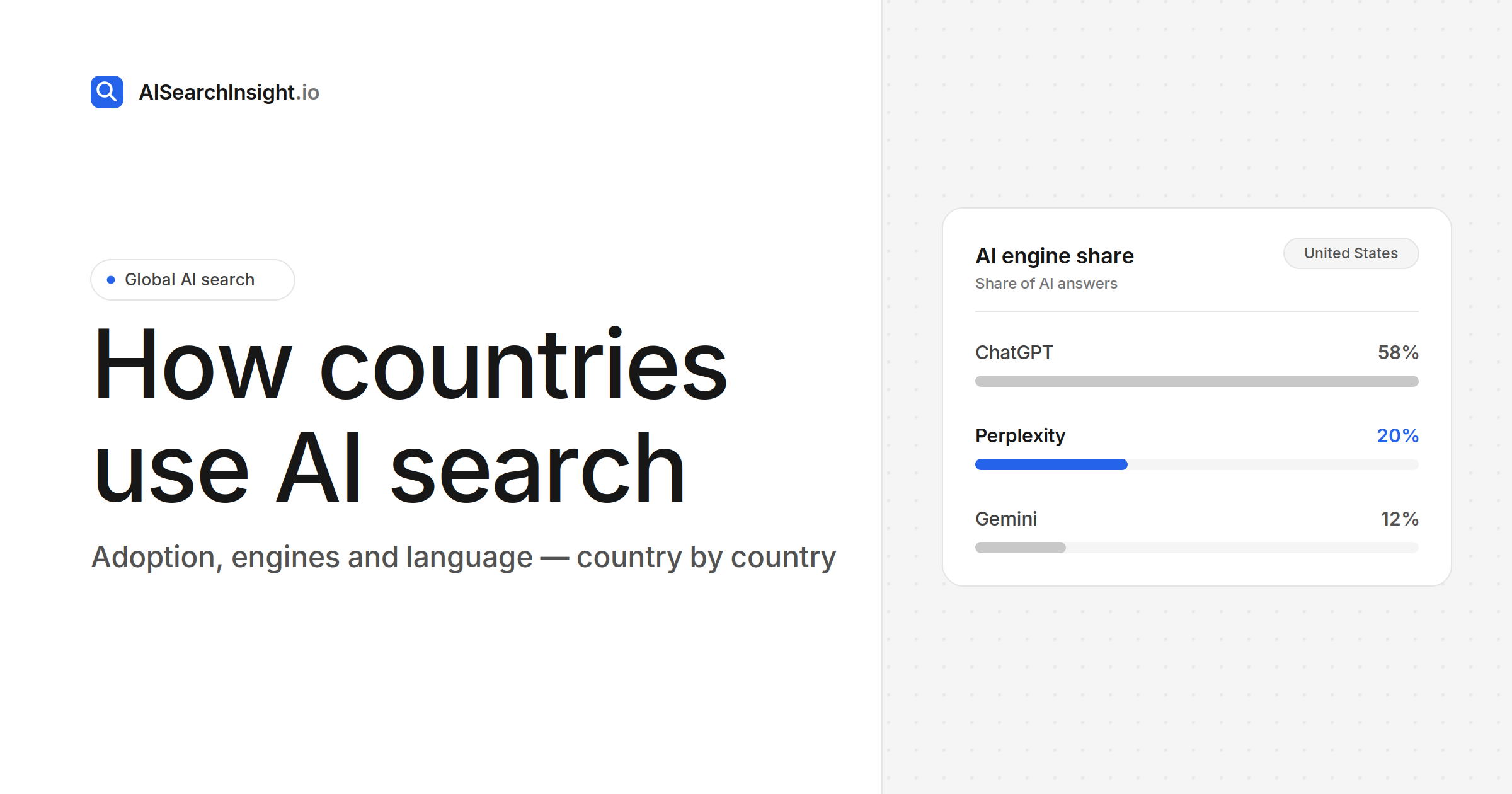
And here, again, local differences kick in. Perplexity is noticeably stronger in the U.S. (about 20% of AI traffic per SE Ranking) than globally. ChatGPT's dominance is highest in the UK (around 84%). In parts of the Global South, DeepSeek becomes the default first choice. In other words: the same brand can be recommended by a different engine in a different country.
What this means for your brand
Let's boil it down to a single conclusion. Visibility in AI search is now simultaneously:
- geographic - a different adoption level and different habits in every country,
- platform-dependent - a different leader in the U.S., the UK, and the Global South,
- linguistic - the model's quality in the local language decides whether you're "seen" at all.
The uncomfortable consequence: you can't assume that because AI recommends you in one market, it will in another. A brand that performs beautifully in English ChatGPT answers can be quietly skipped by Gemini in German or DeepSeek in another region.
That's exactly why aisearchinsight.io exists. Our role sits on the measurement side, not the execution side - in a one-time report we show you how your brand actually shows up (or doesn't) in the answers each AI engine gives: in which markets, in which languages, and to which competitors you're losing your spot. It's a snapshot of where you really stand, not another subscription.
And here's a deliberate choice we made: we're not an agency, and we don't run campaigns. That keeps the diagnosis independent from the delivery, so you get an objective read on the situation before you commit a single dollar of budget. When the report shows that visibility needs to be built over time, we point you to vetted partners who specialize in GEO/SEO and actually run that kind of work.
See where you stand against your competitors
The report shows your brand's presence in ChatGPT, Gemini, Claude, Perplexity and Google AI Overviews - for your market, next to your competitors.
To close
Search didn't disappear. It fragmented - by geography, by platform, and by language. The adoption map in the Microsoft report shows a world now splitting into markets that already ask machines questions and those just getting started. The brands that read that map before their competitors do are the ones that win.
So today's question is very concrete: in how many of those markets does AI even know you exist?