Adapt or Disappear: How AI Is Rewriting the Rules of SEO
For two decades, SEO rested on one simple assumption: rank high in Google and the user will click through to your site. That assumption just stopped holding. Artificial intelligence is stepping in as the broker between a question and its answer - and it is doing so at a pace the market has never seen. The question is no longer “how do I rank higher?” but “will I be part of the answer at all?”
The internet stopped being human
Let’s start with a number that belongs on every opening slide of any strategy conversation. According to the Thales/Imperva 2026 Bad Bot Report, automated traffic crossed 53% of all web traffic in 2025 - up from 51% the year before. Human-generated traffic has fallen to 47% and keeps shrinking.
📊 In 2025, more than half (53%) of all internet traffic came from bots and automation, not people. AI-driven bot activity grew 12.5x in a single year. - Thales/Imperva, 2026 Bad Bot Report
This isn’t a short-term spike. It’s a structural shift. A whole new category has emerged on the automation side - AI agents that don’t just scan pages but interact with them, pull data, and complete tasks on a user’s behalf. Data from HUMAN Security shows AI-agent traffic grew nearly 8,000% year over year in 2025, with OpenAI the dominant player (~69% of observed AI bot traffic), ahead of Meta (~16%) and Anthropic (~11%).
What does that mean in practice? More and more often, the “visitor” to your site isn’t a prospective customer but a model processing your content to answer someone’s question somewhere else - in ChatGPT, in Perplexity, in Google’s AI Overviews. Your content is still working. What moved is the place where you harvest the fruit of that work.
AI Overviews are taking the clicks
You can see it most clearly on the front that touches all of us: Google’s results. A December Ahrefs study (300,000 keywords) shows that the presence of an AI Overview cuts the click-through rate of the No. 1 position by 58%. For comparison, in April 2025 the same team measured a 34.5% drop. In eight months, the problem nearly doubled.
🔻 When an AI Overview appears, the top-ranking page now loses about 58% of its clicks. For every 100 clicks that would historically have reached your page, Google now “keeps” 58. - Ahrefs, December 2025
Other sources corroborate it. Seer Interactive records organic CTR declines of 49-65% for AI Overview queries. An estimated 60% of Google searches now end with no click at all (zero-click search). AI Overviews already appear on roughly half of U.S. queries and are rolling out to more markets and languages.
Then there’s a second wave: users who never start at the search engine. ChatGPT already has around 800 million weekly active users. “Recommend the best tool for X” increasingly happens not in Google but in a chat window.
Is SEO losing its point? Absolutely not
This is the moment when many people panic and declare “the death of SEO.” I think that’s the wrong conclusion. Users haven’t stopped searching - the interface changed, and so did who presents the answer. The work we do doesn’t disappear; its target shifts. Instead of fighting for position alone, we fight to be the source AI deems worth citing.
And here’s the best news: being cited still pays off - in traffic, too. Analyses show that brands cited inside an AI Overview earn about 35% more organic clicks and 91% more paid clicks than those left out of the answer. Visibility in the AI answer is the new “position zero.”
Find out whether AI answers include you
The visibility report shows how often ChatGPT, Gemini, Claude, Perplexity and Google AI Overviews name your brand - and who they name instead of you.
How to win in AI answers
The most important study of the past year on this topic comes from Ahrefs - an analysis of 75,000 brands. Its conclusion turns part of a decade of SEO experience on its head.
🧠 Branded web mentions correlate with AI Overview visibility at 0.664 - more than three times stronger than backlinks (0.218). Brands in the top mention quartile earn up to 10x more visibility than the next group. - Ahrefs, 75,000-brand study
The mechanism is logical. A language model learns the world from text. When independent sources consistently talk about your brand, the model “learns” you’re a known, credible entity worth referencing. A link tells AI where to go. A mention tells it what to trust - and in the world of citations, trust wins.
A few concrete levers the data points to:
- Earned media is the foundation. A Muck Rack analysis (over a million cited links) found that 82% of AI citations come from earned media and 94% from non-paid sources. This isn’t a race to publish more blog posts - it’s a game of getting others to talk about you.
- YouTube is the strongest signal. In the December 2025 update, YouTube mentions turned out to be the single most strongly correlated factor for AI visibility (around 0.737). OpenAI’s and Google’s models were trained partly on YouTube transcripts - well-described video genuinely builds entity recognition.
- E-E-A-T still rules. Pages with strong E-E-A-T signals are cited up to 2.3x more often than high-ranking pages with weak authority. Show your authors, their credentials, and real experience.
- Data and structure raise “citability.” The pioneering GEO study (Princeton, Georgia Tech, IIT Delhi, KDD 2024) found that adding statistics, citations, and clear structure can lift visibility in AI answers by up to 40%. Content with 3+ statistics per 300 words is cited roughly 2.1x more often.
- Google ranking isn’t everything. As much as 90% of ChatGPT citations come from outside Google’s top 20 results. That’s a real opening for smaller brands that don’t yet win on “classic” domain authority.
What to do in the coming week
You don’t need to wait for the perfect strategy. Here’s a first, practical, step-by-step plan:
- Measure your baseline. Ask 20-30 of your customers’ real questions in ChatGPT, Perplexity, Gemini, and AI Overviews. Record whether and where your brand appears - and who shows up instead of you.
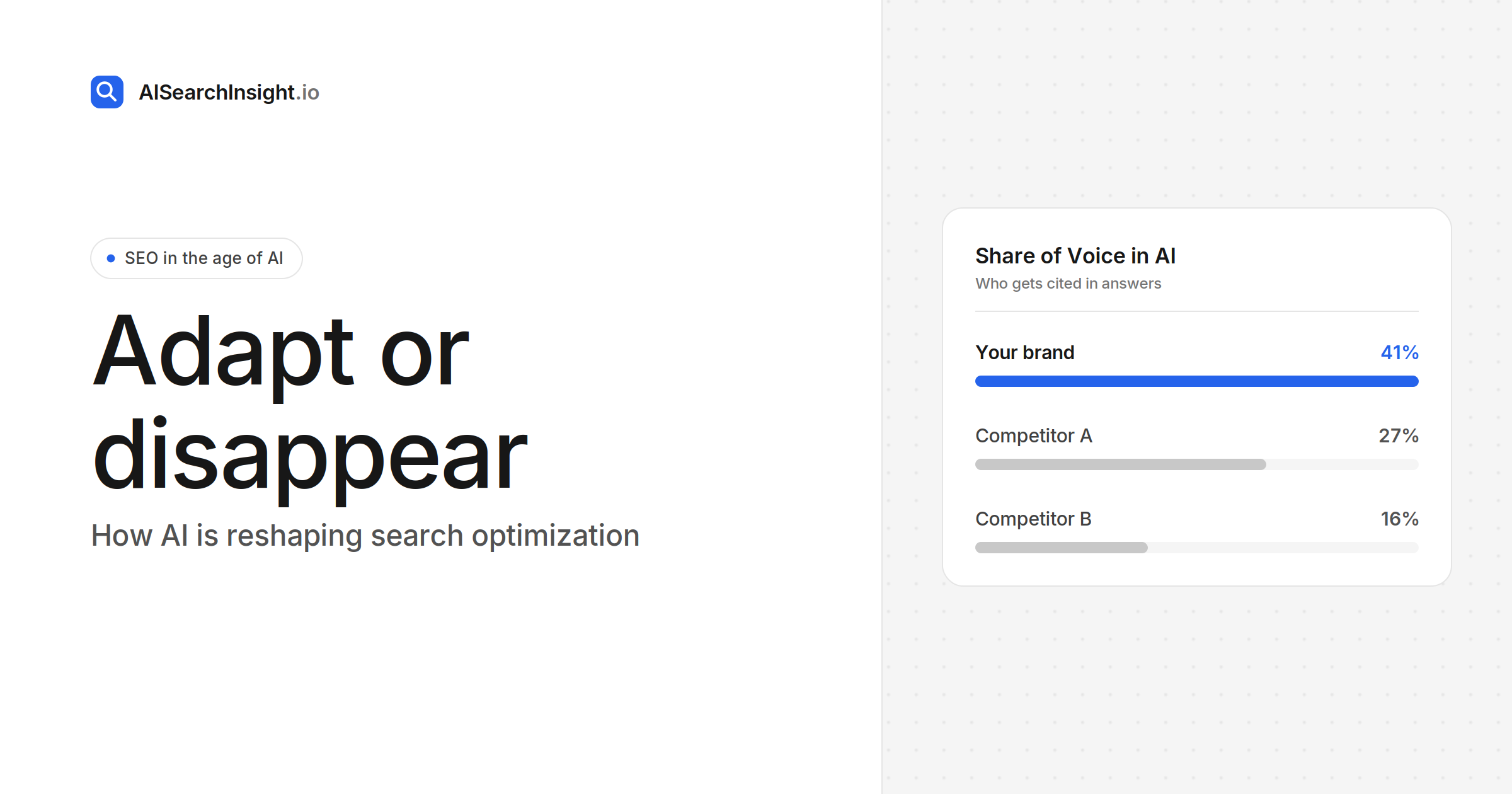
- Count “share of voice,” not positions. In the AI world, what matters is how often you’re cited versus competitors - the new equivalent of rankings.
- Plan for earned media. Instead of another link batch, plan presence in industry publications, “best-of” roundups, podcasts, and video.
- Rewrite key content for extraction. Put the answer in the first 40-60 words, add data, sources, and clear headings.
- Check access for AI bots. Make sure your setup (robots.txt, crawler blocks) isn’t cutting you out of the indexes where you want to be visible.
Adapt or disappear
An internet where more than half the traffic is machine-driven and the search engine increasingly answers instead of linking is not a future scenario - it’s the status quo. Brands that keep measuring success solely by position and clicks from “ten blue links” will fight over a shrinking pie. Brands that build recognition, mentions, and citation-worthy content today will become AI’s default answer in their category.
And that’s the most exciting part: the winner won’t be whoever games the algorithm best, but whoever the world genuinely talks about. The question is - will your brand be part of those answers?
Want to talk about how to prepare your brand for the era of AI-powered search? Send me a direct message.
Sources: Thales/Imperva 2026 Bad Bot Report; HUMAN Security 2026 State of AI Traffic & Cyberthreat Benchmark; Ahrefs (AI Overviews Reduce Clicks, Dec 2025; 75,000-brand study; Dec 2025 update); Seer Interactive; Muck Rack; GEO study (Princeton / Georgia Tech / IIT Delhi, KDD 2024).
Start with a measurement, not a guess
Instead of wondering whether this shift affects you, measure your presence across the five AI engines and see how your competitors compare.